Arabic Salad (Simple & Traditional)

Mar 18, 2026
This post may contain affiliate links.
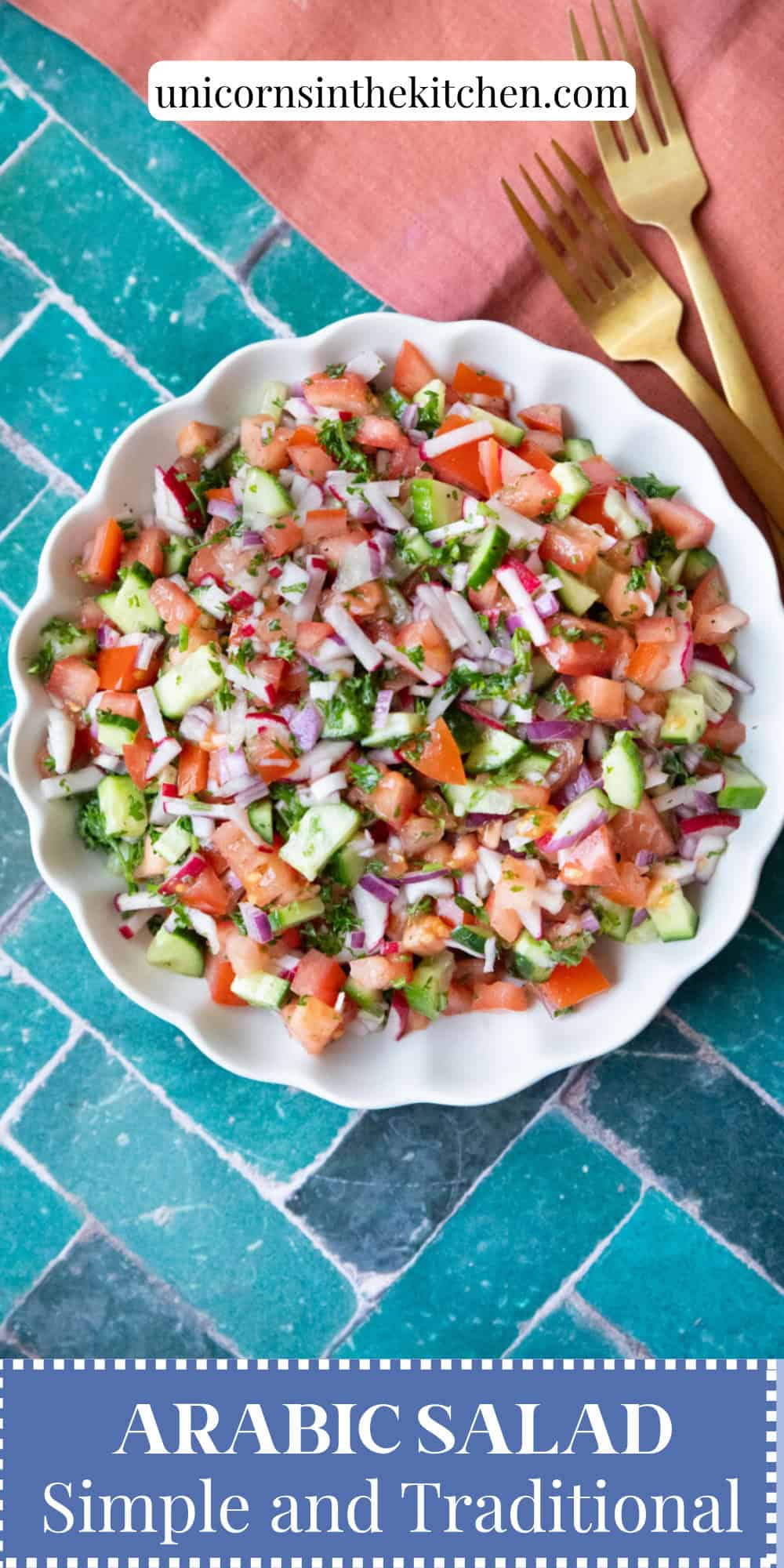
Arabic salad is the everyday chopped salad served across the Arab world alongside almost every meal. The ingredients are simple: tomatoes, cucumbers, red onion, parsley, and radishes, dressed simply with olive oil, lemon juice, salt, and pepper. It’s so easy: no cooking, no marinating, and ready in 10 minutes. Just fresh vegetables and a bright, clean dressing that lets the ingredients speak for themselves.

Every country has its own version of this salad. In Iran it is called Shirazi salad and uses dried mint and verjuice. This recipe is for the “universal” version: the one that shows up on dining tables from Beirut to Dubai without much fanfare, alongside grilled meat, rice dishes, stews, and everything in between. If you want something more elaborate, fattoush takes a similar base and adds toasted pita, sumac, and pomegranate molasses for a heartier salad.
Table of Contents

What is Arabic salad?
Arabic salad, known as salata (سلطة) in Arabic, is the everyday chopped salad eaten across the Arab world. From Palestine to Lebanon to Jordan to Egypt, nearly every meal includes a version of this simple vegetable salad.
The base is always the same: finely chopped tomatoes, cucumbers, parsley, and onion, dressed with olive oil and lemon juice. From there, each region adds its own touches. In Palestine and Lebanon, you’ll often find mint. In Egypt, the salad tends to be more garlicky. Some versions go heavy on radishes for extra crunch or add in sumac for extra tang; again, the ingredients listed below are intended to be pretty close to a “universal” version.
Ingredients
- Tomatoes: Use firm, ripe tomatoes. Roma tomatoes are ideal because they are less watery than beefsteak tomatoes. If your tomatoes are very seedy, scoop out the seeds before chopping to avoid a watery salad.
- Cucumbers: Persian or English cucumbers work best. Persian cucumbers have thinner skin and fewer seeds so you do not need to peel or deseed them.
- Red onion: Finely chop it so it blends into the salad rather than overpowering every bite. If your onion is very sharp, soak the chopped pieces in cold water for 10 minutes then drain before adding.
- Parsley: Fresh flat-leaf parsley. It adds brightness and is a non-negotiable in Arabic salad. Chop it finely so it distributes evenly.
- Radishes: Cut into small pieces. They add a peppery bite and a satisfying crunch that sets this salad apart from similar versions.
- Olive oil: Use a good quality extra virgin olive oil. It is one of only three dressing ingredients so the quality matters.
- Lemon juice: Freshly squeezed only. Bottled lemon juice will flatten the dressing.
- Salt and black pepper: Season generously and taste before serving. A well-seasoned salad is the difference between flat and bright.
How to Make Arabic Salad
Chop the vegetables: Dice the tomatoes and cucumbers into small, even pieces. Finely chop the red onion and parsley. Cut the radishes into small pieces. The key to a good Arabic salad is uniform, fine chopping so every bite has a bit of everything.


Combine: Add all the chopped vegetables and parsley to a large bowl and toss to mix.
Dress: Drizzle with olive oil and freshly squeezed lemon juice. Season with salt and black pepper.


Toss and taste: Toss well to coat everything evenly. Taste and adjust the lemon, salt, or pepper as needed. Serve immediately or let it sit for a bit so the tomatoes release their juices.
Arabic Salad Dressing
The traditional Arabic salad dressing couldn’t be simpler: just olive oil, fresh lemon juice, salt, and pepper. You’ll notice that I didn’t even prepare it in a separate bowl in the instructions above. There’s no vinegar, no garlic, no elaborate emulsification – the dressing should complement the vegetables without overpowering them.
The ratio I use is roughly 3 tablespoons olive oil to the juice of one lemon, but taste and adjust. Some cooks add a pinch of sumac for extra tanginess, though this is more common in Palestinian and Lebanese versions. The key is using good quality extra virgin olive oil and freshly squeezed lemon juice.
Tips for the Best Arabic Salad
Chop everything finely and uniformly: This is what makes an Arabic salad feel cohesive and not just a “pile of vegetables.” Aim for pieces no larger than half an inch.
Taste and adjust: Lemon juice and salt are the soul of this dressing. Start with the amounts in the recipe, taste, and add more of either until it tastes bright and well-seasoned.
Soak the onion if needed: If your red onion is very pungent, soaking the chopped pieces in cold water for 10 minutes takes the edge off without sacrificing flavor.
What to Serve With Arabic Salad
Arabic salad belongs on the table with almost any Arabic main. It is particularly good alongside kabsa and chicken mandi, where its bright lemon dressing cuts through the richness of the spiced rice.
It also pairs naturally with grilled meats. Serve it next to kofta kebab, kibbeh, or arayes for a full spread. For a quick weeknight meal, it works beautifully alongside my Middle Eastern ground beef bowl.

How is Arabic Salad Different from Other Middle Eastern Salads?
Arabic salad is often confused with similar salads from the region. Shirazi salad is the Persian version, made with dried mint and traditionally dressed with verjuice rather than lemon. You typically won’t find parsley or radishes in Shirazi salad.
My Middle Eastern chopped salad uses sumac and bell pepper and has a more complex dressing. Arabic salad is simpler and more stripped back: just vegetables, lemon, and olive oil. Tabbouleh is a different salad altogether, built around parsley and bulgur rather than cucumber and tomato.
Storage
You can store the leftovers in a container and refrigerate for up to 2 days. The salad won’t be as fresh, but it will still be good. To prep ahead of time, chop the vegetables and store in the fridge for up to 24 hours. Add the olive oil, lemon, salt, and pepper right before serving.
Frequently Asked Questions
Not always. The most traditional everyday version uses just olive oil, lemon juice, salt, and pepper. Sumac is a popular addition in many Lebanese and Palestinian recipes but is not essential to the base recipe.
Fattoush is a more elaborate salad that includes toasted or fried pita bread, sumac, and often pomegranate molasses in the dressing. Arabic salad is simpler: no bread, no sumac, just fresh vegetables and a plain lemon dressing.
Chop the vegetables ahead and store undressed. Add the olive oil, lemon juice, salt, and pepper right before serving to keep the salad crisp.
Arabic salad is called salata (سلطة) in Arabic. Depending on the region, you may also hear it called salata arabiyeh, salata baladi, or simply salata.
Yes. Arabic salad is low in calories, high in vitamins A and C, and rich in fiber. The olive oil provides heart-healthy fats, and there’s no added sugar. It’s naturally vegan and gluten-free.
Did you make this recipe? I’d love to hear about it! Please comment and leave a 5-star🌟 rating below. You can also follow us on Instagram, Facebook, Pinterest or subscribe to our newsletter to get a free e-Cookbook!
More Salad Recipes


Arabic Salad
Video
Ingredients
- 4 tomatoes
- 2 cucumbers
- 1 red onion
- 6 radishes
- 1 cup parsley, chopped
- 3 tablespoons olive oil
- 1 lemon, juice of
- 1 teaspoon kosher salt
- 1/4 teaspoon black pepper
Instructions
- Chop the tomatoes, cucumbers, red onion, and radishes into small, even pieces and place in a large bowl. Add in the parsley as well.
- Drizzle with olive oil and freshly squeezed lemon juice.
- Season with salt and black pepper and toss well to combine.
- Taste and adjust seasoning if needed. Serve immediately.
Notes
Nutrition
Nutrition information is automatically calculated, so should only be used as an approximation.